




25 February 2026
Fixed income
| “By looking beyond home markets, we think investors can access a wider opportunity set, enhance portfolio resilience, and unlock sources of return that are unavailable domestically. We believe that concentrating an investor’s portfolio primarily within their home market can leave it vulnerable, undermining its overall resilience and potentially exposing it to unnecessary risks” |  |
Why a global fixed income allocation makes sense
In our view, an increasingly fragmented global economy means fixed income opportunities are no longer moving in lockstep. We believe a global approach can help investors reduce concentration risk, improve portfolio resilience and unlock a broader range of return drivers across rates, credit and currencies.
Key takeaways
- Global diversification can reduce volatility
Allocating beyond domestic bond markets helps mitigate concentration risk and smooth portfolio outcomes by accessing a wider range of economic, policy and credit environments. - Risk‑adjusted returns have historically been stronger
Over the past 20 years, the Global Aggregate bond market has delivered stronger risk‑adjusted returns than US‑only bond allocations, while the US market has rarely been the top performer despite its size. - Policy divergence is creating new opportunities
Since 2025, central bank policy paths have increasingly diverged. This has opened up attractive cross‑market opportunities across yield curves, interest rates and currencies as markets move out of sync. - Yield‑curve roll‑down is re‑emerging as a return driver
As yield curves steepen in anticipation of future rate cuts, roll‑down is becoming a more meaningful contributor to fixed income returns, particularly for investors with flexible global mandates. - Credit spreads vary by region and can be actively exploited
Regional credit spreads often diverge and later re‑converge. A global approach allows investors to overweight markets or issuers where valuations appear more attractive and adjust exposures as pricing normalises. - Structural issuance trends are reshaping global markets
Rising US corporate issuance to fund AI‑related investment and record levels of reverse‑Yankee issuance are creating fresh relative‑value and sector‑rotation opportunities for global investors. - A deeper and more diverse opportunity set
The global investment‑grade universe spans the US, Europe, the UK, Canada and Asia, offering meaningful depth across regions, issuers and sectors. - Regional markets provide differentiated sector exposure
Sector composition varies widely by geography, enabling investors to tilt portfolios toward preferred themes such as US technology, UK utilities and financials, eurozone financials, or Canadian energy. - Greater resilience during periods of stress
Historically, globally diversified credit portfolios have experienced less spread widening than regional allocations during market crises, reinforcing the diversification benefits of a global approach.
Figure 1: Diversifying from the centre of crisis is beneficial1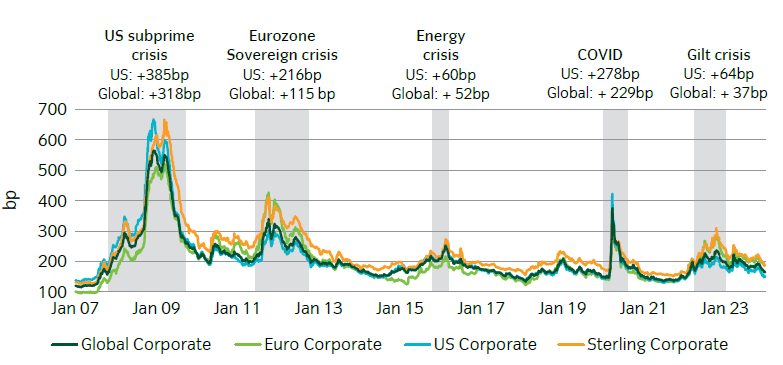

Click here to read the full whitepaper
777 kb


