

| Many retirees need reliable income with flexibility and credible long-term security. Flex-then-fix designs calculate sustainable spending, protect growth, and manage annuity pricing risks, helping portfolios deliver salary-like income while building secure lifetime income over time. |  |
What you need to know
- Treat the future annuity as a target liability from day one to stabilize later-life income.
- Engineer protected growth exposures to support income while limiting early-retirement drawdown risks and volatility.
- Address sequencing risk explicitly using CDI, liquidity reserves, and disciplined rebalancing and collateral rules.
- Calculate and recalibrate sustainable income periodically, reflecting markets, rates, longevity assumptions, and retained flexibility.
How to make the most of flexibility in retirement
Retirees value capital access early, then prioritize security later. Flex-then-fix uses flexibility when it matters and converts capital into secure lifetime income when certainty rises in importance. Sustainable spending is calculated on the member’s behalf, with clear trade-offs if higher withdrawals or capital access are chosen.
Four principles to build a better flex-then-fix strategy
1. The member should receive a simple, salary-like experience
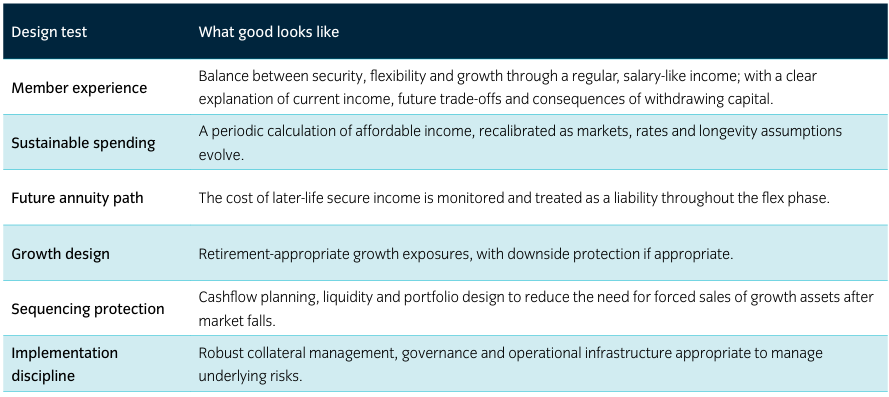
Income should be presented as a regular payment. The solution calculates sustainable spending, accounting for assets, future cashflows, and the cost of securing later-life income, enabling confident spending decisions without complex member calculations.
2. The future annuity should be treated as a target from day one
Future annuity costs move with yields, credit conditions, inflation expectations and longevity assumptions. Liability-driven investment (LDI) based concepts can hedge rate sensitivity, stabilizing the relationship between today’s assets and the future income objective.
3. Growth should be engineered for retirement
Retirement-appropriate growth can surrender a portion of extreme upside to gain better downside protection. Protected growth aims to participate in economic growth while limiting early-retirement losses that could impair the long-term income path.
4. Sequencing risk must be addressed explicitly
Cashflow-driven investing (CDI) secures near-term income payments and reduces forced sales after market falls. Liquidity reserves, collateral management and rebalancing rules work together to protect today’s payments without compromising tomorrow’s income.
What trustees and providers should look for in a flex-then-fix approach
Governance should oversee an integrated retirement-income journey: define the fix age implications; calculate sustainable income and recalibrate; monitor annuity costs; set hedging and retained-risk policies; designate cash sources in stress; and shape protected growth exposures. Clarity on member communication and adjustment protocols is essential.
The goal: confidence, not complexity
Flex-then-fix aims to deliver a salary-like income experience, manage risks professionally, and build later-life security from the outset. Members can spend with confidence, while trustees oversee implementation discipline across LDI, CDI, protected growth, liquidity and collateral processes.
Figure 1: Governance and implementation features that strengthen retirement income delivery.
Conclusion
Flex-then-fix can help portfolios deliver sustainable, salary-like income early and secure lifetime income later. Liability-aware hedging, CDI cashflow planning, and protected growth can reduce sequencing risk and interest-rate exposure, enabling more confident spending and robust governance of the retirement-income journey.