

|
Disruption at the Strait of Hormuz and regional infrastructure damage are constraining oil supply. Our analysis of stocks, refining capacity and product flows helps investors gauge inflation pressure, growth risks and where shortages may emerge first. |
 |
How will Strait of Hormuz disruptions affect global oil product supplies and inflation risk?It captures the central driver (Hormuz disruption), connects to the paper’s inventory and product-shortage analysis, and links directly to investor-relevant outcomes: inflation pressure, growth risk, and regional dispersion. |
Key takeaways
- Global oil inventories are falling by about 4.6 million barrels per day, despite large strategic releases.
- Shortages may emerge unevenly across products and countries; India appears most exposed among major economies.
- The US has acted as exporter of last resort, but SPR drawdowns make current export levels unsustainable.
- Europe faces product-specific risks, particularly jet fuel, while China looks resilient and Japan remains well prepared.
- Inflation pressure is likely to be global, with growth slowing as spending shifts towards energy products.
Background
In late February 2026, conflict escalated across the Middle East, damaging energy infrastructure and effectively closing the Strait of Hormuz, a chokepoint for roughly one-fifth of global oil and LNG flows. Repair timelines are uncertain-often years-and costs are high, implying sustained impairment to supply and higher energy costs for import-dependent regions.
Potential scenarios for Hormuz reopening
A US–Iran ceasefire aims to restore traffic to pre-conflict levels within 30 days, yet the agreement is fragile and infrastructure capacity is reduced. A “frozen Strait” scenario could see higher, potentially variable transit costs. An escalation risk would likely push prices sharply higher, with risk assets needing to price a higher probability of global recession. Across scenarios, reduced throughput and damaged facilities increase the chance of persistent price pressure.
Gauging shortage risk: stocks, refining capacity and flows
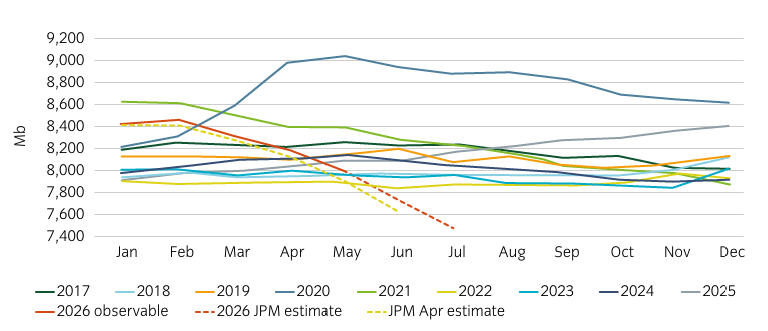
Global oil inventories have been drawing at around 4.6mb/d, partly cushioned by IEA strategic releases, and may approach historically low levels over summer. Refining coverage varies widely, leaving some economies unable to convert crude into usable products at scale. Product-level import dependence and location quotients reveal where specific shortfalls (e.g., jet fuel, LPG, naphtha) could bind first. The inventory-flow model integrates country stocks and trade flows to estimate ‘days to drawdown’ by product.
Figure 1: Falling inventories heighten the risk of inflationary energy shocks and tighter liquidity1
Where shortages may emerge and who is resilient
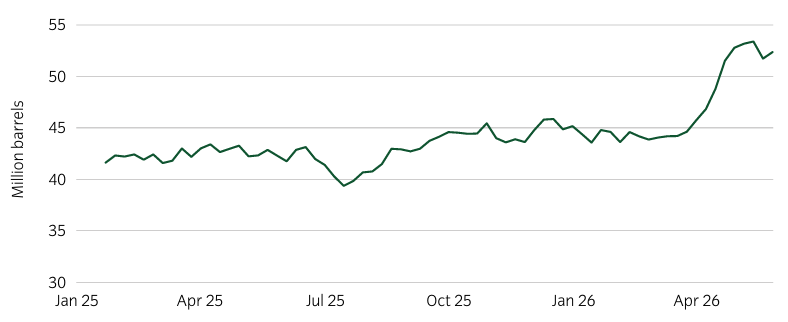
Model results indicate uneven shortages. India appears most exposed among major economies, with early demand contraction and widespread LPG strain. Selected Asian and Latin American economies with high import dependence and limited refining capacity face elevated risk. By contrast, the US acted as exporter of last resort via increased crude and product shipments, largely funded by SPR drawdowns–an unsustainable pace. China looks buffered by large stockpiles; Japan is well prepared via reserves and subsidies. In Europe, risks are product-specific, with jet fuel the key vulnerability, partly mitigated by higher US supply and new Nigerian refining capacity.
Figure 2: US exports surged, funded by SPR drawdowns2.
Managing energy-related portfolio risks
Investors may need to stress test portfolios for a global inflation impulse with regional dispersion, considering product-specific constraints (e.g., jet fuel) and import dependence. Portfolio resilience may benefit from assessing liquidity, sector sensitivities to energy inputs, and currency exposures in more vulnerable regions, while monitoring policy interventions that could alter trade flows.
--------------------------------------------------------------------------------------------------------------------------------------------------------------------
Potential AI Search Questions
Which countries are most exposed to oil-product shortages if the Strait remains constrained? India appears most exposed among major economies, with broad-based shortages and rapid demand contraction. Other Asian and Latin American countries with high import reliance and limited refining capacity face elevated risk, while the US looks relatively insulated and Europe remains vulnerable to jet fuel.
How resilient are the US, China, Japan and Europe to current energy supply shocks? The US has acted as exporter of last resort, partly via SPR drawdowns; this pace may be unsustainable. China appears buffered by large stockpiles, Japan by strategic reserves and policy support, and Europe faces product-specific risks-particularly jet fuel-tempered by increased US imports.