





Please note: AI generated transcript.
Text on screen: Bonds beyond borders.
In our view, focusing only on domestic bond markets can limit the opportunity available to investors.
By contrast, a global approach can broaden sources of return, lower volatility, and improve risk-adjusted outcomes as policy and economic trends differ across regions.
Policy divergence, shifting macro trends, and geopolitical risks can create meaningful differences in yield curves and credit spreads, offering opportunities to enhance portfolio resilience and reducing vulnerability to local shocks.
By contrast, concentrating domestically may mean missing additional potential sources of return.
Meanwhile, in credit markets, spreads remain tight compared to recent historical levels.
However, absolute levels of yield remain healthy.
Combined with relatively subdued volatility, we think this current backdrop is constructive for high-quality global credit.
Looking globally in credit markets can also offer the potential to access a more diverse investment universe, allowing investors to secure a substantially larger opportunity set than their home markets provide.
In addition, sector leadership and fundamentals differ by region, meaning investors can tilt toward markets that boast relatively stronger balance sheets, healthier free cash flow, or better pricing power at an aggregate level.
A global approach lets investors diversify by issuer type, sector mix, maturity profile, and currency exposure.
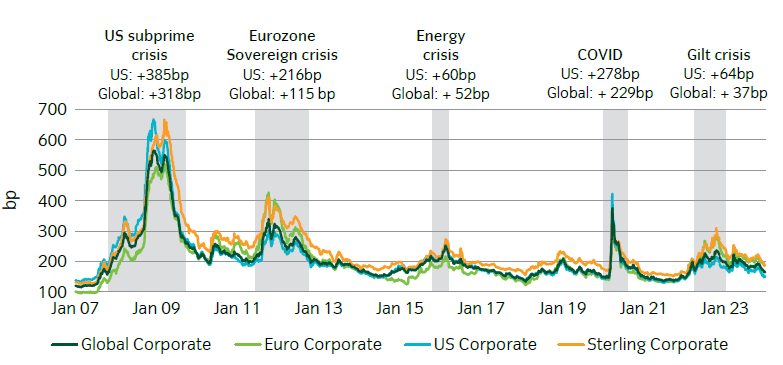
Looking globally can also potentially offer lower volatility during times of crisis.
Periods of market stress rarely impact all regions and sectors the same way.
By contrast, a global credit approach spreads exposure across policy regimes, growth profiles, and currency blocks, which can dampen drawdowns and stabilize outcomes when local shocks hit.
To conclude, we think allocating globally can offer investors a wider opportunity set and better tools for risk management than only focusing within an investor's home market.
Different policy cycles, credit conditions, and sector dynamics all point to bond portfolios benefiting from allocating beyond borders.
We explore these themes further in our paper.


