




Long-dated US Treasury yields have hit the headlines, as the Treasury intervened in the market. We believe that recent yield increases reflect supply and demand dynamics, rather than concerns about US solvency. Price action may have created opportunities for active investors, especially at the front end of the curve.
US Treasury yields are back in the headlines
The 30-year US Treasury yield reached 5.3% in August 2026 – its highest level since 2007.
This preceded an unscheduled announcement from the US Treasury on August 19, upsizing an established bond buyback program.
The program itself is modest, with each buyback representing less than 0.1% of the longer-dated Treasury market it is targeting1. However, the signal that the Treasury is willing to proactively attempt to contain long-term yields has helped renew attention on US debt costs. Although headlines are focused on instability in long-term yields, we see potential opportunities in shorter maturities.
US Treasury supply, rather than US solvency, may be a key factor pushing up yields
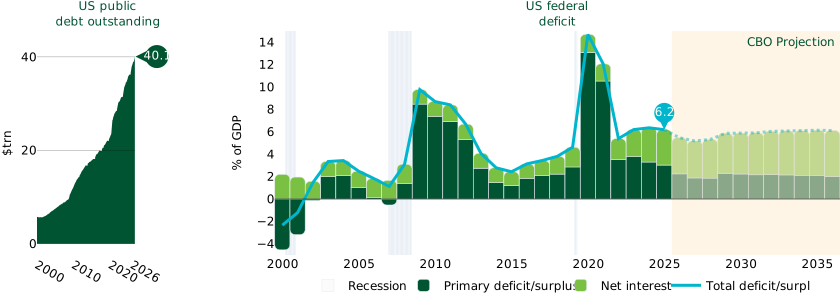
The total level of US federal debt reached a psychological $40trn level on August 18, the day before the Treasury’s announcement.
Its upward trajectory is set to continue. The Congressional Budget Office (CBO) estimates the annual fiscal deficit trending at ~6% of GDP for the foreseeable future (Figure 1).
Figure 1: Investors have good reason to be concerned about US debt and deficits2
However, we do not believe markets are pricing in an impending fiscal crisis. US credit default swaps (CDS) have narrowed through August 2026, in our view reflecting relatively healthy US nominal GDP growth. Meanwhile, Treasury bond auctions have remained functional, with no signs of foreign capital flight or red flags from currency markets.
The deficit does, however, imply substantial and continuing borrowing at a time when demand may be more price-sensitive.rkets. The deficit does, however, imply substantial and continuing borrowing at a time when demand may be more price-sensitive.
Why have US Treasury yields come under pressure?
1) US markets have been caught in a global trend
Rising yields this year have been a global story. Foreign yields have generally risen in step or more than they have in the US (Figure 2).
Figure 2: The US is not alone in suffering rising long-term debt costs3
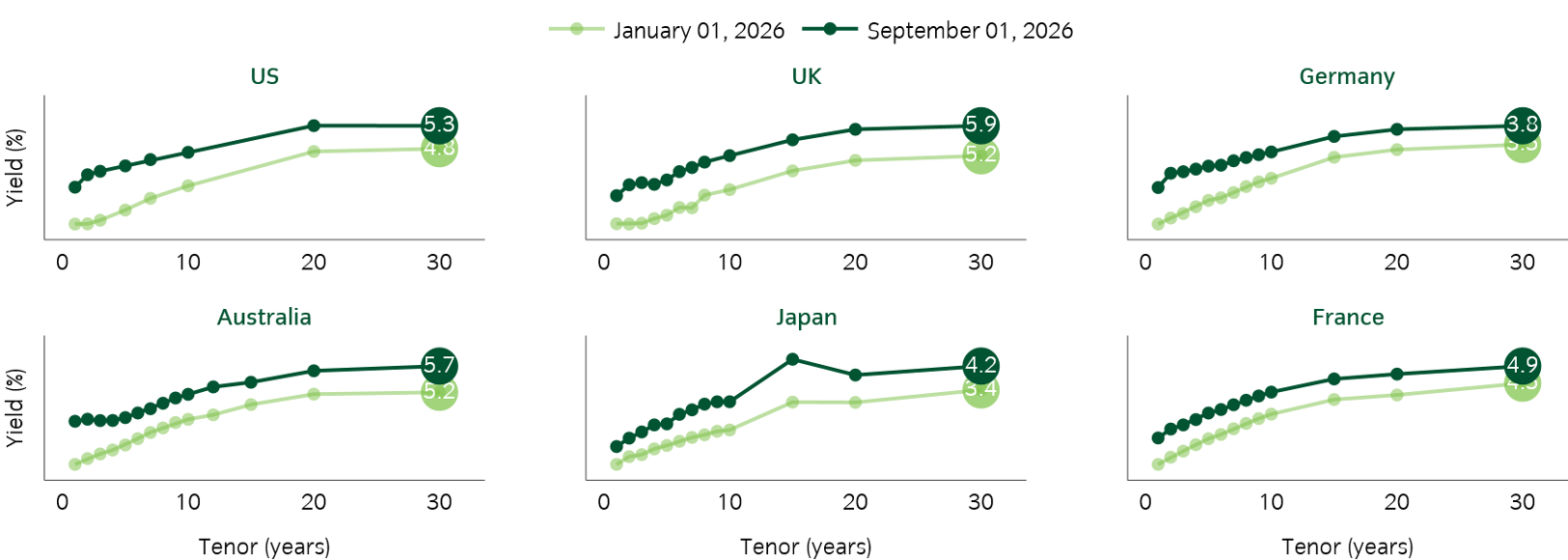
The drivers have, in some cases, been related to policy trends, including concerns around France's budget outlook and Germany's defense spending plans. In Japan, the central bank has also been normalizing interest rates. For some regions, domestic yields may have started offering an alternative to US Treasuries.
2) Long-dated corporate issuance may offer an alternative to long-dated US Treasuries
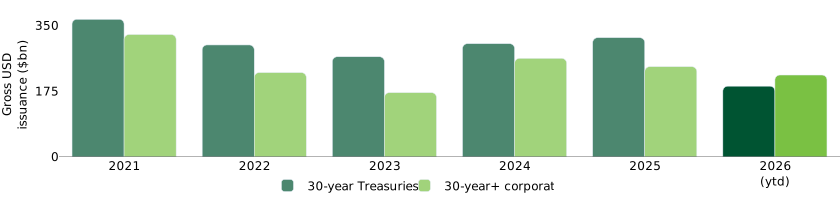
This year, gross US dollar corporate issuance of maturities of 30 years or longer is on track to outpace 30-year Treasury issuance for the first time since the pandemic (Figure 3).
The largest 30-year-plus deals have been AI-related issues from Amazon, Google, Meta and Oracle4. This has created some potential competition for Treasuries, particularly given the first two are rated AA, the same as the US government. Overall, US dollar hyperscaler debt issuance has reached $157bn in the US year-to-date, versus $93bn in 2025, potentially contributing to pressure across the curve5.
Figure 3: Long-dated corporate issuance may have become competition for Treasuries6
3) The new regime at the Fed has kept investors guessing
The Federal Reserve (Fed) is no longer expanding its balance sheet, leaving increasingly price-sensitive private investors to absorb most incremental Treasury bond supply.
Further, under Chair Kevin Warsh the Fed has ceased to publish forward guidance. This may have increased uncertainty around the future path of inflation and monetary policy and resulted in investors demanding a higher “term premium” in longer-dated bonds as compensation.
Warsh has noted that rising bond yields were working to tighten financial conditions, helping the central bank to achieve price stability. Investors potentially took this as a signal that the Fed had a measure of tolerance of long-dated yields rising.
US markets may offer opportunities across the curve, particularly at the front end
For all the attention long-dated Treasury yields have received, US yields have risen further at shorter maturities this year7, “flattening” the shape of the yield curve.
Macroeconomic developments could help reverse some of these trends in the near term.
For example, clearer evidence of easing core inflation, a less hawkish Fed trajectory, and clarity from the central bank around its balance sheet policy could help calm investors and increase demand for Treasury bonds.
However, we expect such developments may have a larger impact on the front of the curve than the long end.
For long-dated yields to sustainably fall, we believe it would ideally take an improvement in the US fiscal trajectory (and thus a lighter bond supply calendar). At this point, there is no sign of any political will for that.
However, in the case of a deeper selloff, higher yields may at some point become attractive to many foreign investors. Patient investors may possibly find opportunities at the long end in time.
Conclusion: the shorter end of the curve may be worth watching
We believe that short and intermediate-dated fixed income exposure, along with “relative value” trades that aim to benefit from the US yield curve returning to a steeper shape, could be worth considering in the current environment. Tactically, investors may also find opportunities at other tenors. Global investors may also find several opportunities in non-US markets.
Ultimately, we believe higher long-term and near-term yields may enhance fixed income’s broader appeal. Active investors may also find strategic and tactical opportunities through targeting value at specific points of the yield curve or through relative value trades.


