




High yield potentially offers a surprising level of diversification against AI-related disruption, as well as potentially compelling AI-related opportunities of its own.
High yield has a relatively low direct exposure to AI
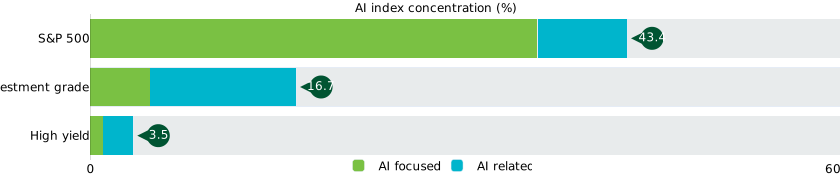
Issuers focused on cloud computing, semiconductors or digital infrastructure for AI workloads only comprise c.1% of the US high yield market. Further, businesses increasingly pivoting towards AI‑related products and services comprise another c.2.5%.
These concentrations are dwarfed by comparable exposures in US investment grade and (particularly) equity markets (Figure 1).
Figure 1: High yield markets have lower direct exposure to AI than investment grade and equities1
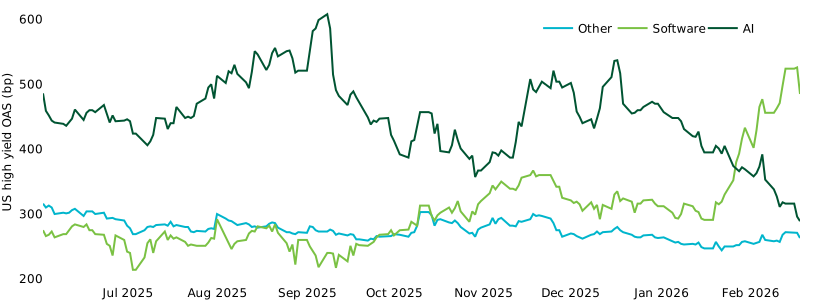
High yield may also be less exposed to AI disruption. Software companies have returned -23.7% year-to-date, by some distance the weakest sector in the S&P 500 Index2, on concerns that AI platforms and agents could disrupt their business models. High yield software companies have similarly struggled, widening by over 200bp so far this year (Figure 2).
Figure 2: Software companies have struggled this year over AI disruption fears3
These concerns have contributed to US equities underperforming global equities year-to-date by the largest margin since 20084 (with the tech-heavy Nasdaq Composite and Magnificent 7 indices even in negative territory5). However, US high yield has been stable by comparison, with excess returns in positive territory, only slightly underperforming its euro high yield counterpart6.
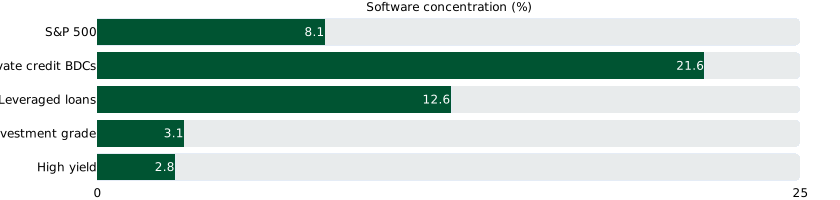
This is largely because the US high yield market has particularly low software exposure (Figure 3). Private credit is most exposed, with software accounting for the largest sector concentration of business development companies (BDCs) (Figure 3)
Figure 3: High yield also has a particularly low exposure to the software sector7
Of course, the AI revolution remains at an early stage. It will likely take time before disruption risks across sectors become clearer, but we are closely watching sectors like human capital services, consumer intermediation, payroll, tax, financial processing, online education, legal services and digital marketing for potential signs of AI-related vulnerabilities.
Although US high yield would not be immune to worst-case scenarios, the market currently offers relatively high concentration (versus investment grade) to what we believe are potentially lower risk sectors like basic industry, energy and capital goods.
High yield may also offer compelling AI opportunities
This is not to say that the high yield market does not offer potentially compelling AI opportunities of its own.
AI focused high yield issuers have performed particularly well year-to-date (Figure 2) but still offer a ~120bp pickup over the broader high yield market and ~90bp over single B debt8.
As with other credit markets, AI issuance has been on the rise, representing ~12% of new high yield supply so far this year. Insight’s systematic models have flagged potential (overweight and underweight) security selection opportunities. For example, during February, our models noted CoreWeave9, a leading “neocloud” provider, as a potential value-based overweight candidate. The issuer notably offers ~10% yields for four‑ to five‑year debt, a sizable premium over investment grade “hyperscalers” (such as Microsoft, Amazon, Google and Meta9) which mostly have AAA to AA ratings and tend to offer ~4% yields at comparable maturities.
Within the software sector, we believe caution is warranted, but our systematic models indicate some potential overweight opportunities in specific credits that offer compelling coupon income as compensation for risk.
High yield may offer diversification and opportunity through the AI revolution
The AI revolution will be potentially characterized by substantial opportunity and disruption. At present, we believe a systematic approach to the high yield market may be well placed to help investors navigate both.


