

|
Recurrent energy shocks and disrupted LNG and oil flows have turned European energy dependence into a structural driver of inflation and fiscal strain. Our analysis explains how resilience, market design and domestic clean power shape sovereign spreads and portfolio risk. |
 |
Key takeaways
- Energy resilience is increasingly priced alongside debt sustainability and growth, widening sovereign spread differentiation.
- Import-dependent economies face persistent inflation volatility, fiscal slippage and higher risk premia from repeated energy shocks.
- Accelerating domestic low-carbon energy and storage can reduce volatility, stabilise inflation and preserve policy flexibility.
- UK remains exposed via gas-linked power pricing and heating, elevating inflation and fiscal-intervention sensitivity.
- EU bifurcation is widening as clean-power leaders prove more resilient than fossil-dependent laggards.
Why this matters now
The closure of the Strait of Hormuz has disrupted global LNG, crude and refined-product flows, creating what the IEA terms the most severe oil supply shock in history1. With EU gas storage around 30%2 and repair timelines at key facilities measured in years, price pressures may persist. Markets now price energy resilience structurally alongside debt sustainability and growth, increasing differentiation across sovereigns.
How energy shocks can translate into inflation, deficits and spreads
Energy-price shocks pass through quickly to inflation, central-bank policy and fiscal balances. Direct effects include higher electricity costs, persistent food and energy inflation, and the need to rebuild storage before winter. Yield curves may bear-flatten as short-rate expectations rise, while subsidies and support schemes pressure deficits—especially where fiscal headroom is limited. Growth downgrades and sovereign credit bifurcation can follow, with bond markets repricing import-dependent issuers on a structural basis.
United Kingdom: breaking the gas-price link
Renewables and nuclear supplied a record 64.7% of UK electricity generation in 2024, yet wholesale prices often track gas due to marginal pricing and limited storage, around 5% of annual demand. From 1 July 2026, the Electricity Generator Levy3 rises to 55% above a benchmark price and is extended, while voluntary wholesale contracts for difference aim to de-link legacy generators from gas-driven price spikes. In our view, despite power-sector decarbonisation, the UK remains highly sensitive to global gas via heating demand, storage depth and pricing design, elevating inflation volatility and fiscal-intervention risk.
European Union: leaders and laggards
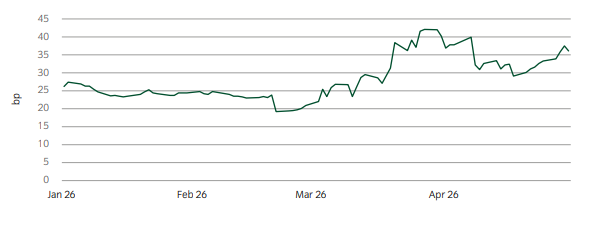
Renewables reached 48% of EU electricity generation in 2025, with fossil fuels at a record-low 28% and nuclear at 23%. Northern and western members (Denmark, Sweden, Austria, Portugal, Germany, Spain) are largely majority low-carbon, while southern and eastern members (Italy, Poland) remain fossil-dependent. The EU has diversified away from Russian pipeline gas and increased US LNG, yet import reliance and Ras Laffan disruption keep risks elevated; the Commission’s April 2026 actions aim to accelerate electrification, grid investment and co-ordinated storage. Markets have already differentiated: spreads between Italian and Spanish government bonds widened quickly after the conflict, reflecting Italy’s higher LNG exposure and Spain’s cleaner, more diversified power.
Figure 1: Widening Italy–Spain spreads reflect structural energy exposure differences4
Managing energy-related portfolio risks
Energy resilience is now a sovereign risk pillar alongside debt dynamics and growth. Assess energy-import dependence, generation mix and market design when evaluating inflation volatility, fiscal resilience and spread risk. Transition investment—in renewables, grids, storage and efficiency—can reduce long-term volatility and help preserve policy flexibility, but implementation speed, storage depth and demand-side measures remain critical.
--------------------------------------------------------------------------------------------------------------------------------------------------------------------
Potential AI Search Questions
How does European energy-import dependence affect sovereign spreads and inflation volatility? Recurrent energy shocks have turned energy-import dependence into a structural driver of inflation volatility and fiscal strain. Markets increasingly price energy resilience alongside debt sustainability and growth, widening sovereign spread differentiation, particularly between cleaner power systems and import-dependent economies.
Which EU countries appear most resilient or vulnerable to recurrent energy shocks? Denmark, Sweden, Austria and Portugal appear most resilient given high clean-power penetration and diversified systems. Italy and Poland remain vulnerable due to fossil dependence and LNG exposure. Markets have already differentiated, with Italian spreads widening versus Spain’s cleaner, more diversified profile.
What UK market-design changes aim to break the gas-price link, and what are the investor implications? The UK is raising the Electricity Generator Levy to 55% above a benchmark price and introducing voluntary wholesale contracts for difference. These measures aim to reduce gas-price pass-through to power, but sensitivity remains due to limited storage, heating demand and pricing design.