

| Retirees need sustainable income that balances early flexibility with later-life security. Insight outlines a flex-then-fix architecture that pays salary-like income today while funding and protecting a credible path to secure lifetime income. |  |
What you need to know
- Flex-then-fix must manage retirement income from day one, not drawdown followed by an annuity.
- Treat the future annuity as a liability to fund, hedge and monitor continually.
- Engineer protected growth to participate in markets while limiting retirement-impairing drawdowns.
- Address sequencing risk explicitly with CDI, liquidity reserves and disciplined collateral management.
How to make the most of flexibility in retirement
Retirement success is measured by sustainable income, not pot size. Early retirement benefits from flexibility, capital access and adjustable spending; later retirement prioritises security, simplicity and a guaranteed income floor. In our view, an effective flex-then-fix approach preserves flexibility when it is valuable and builds later-life security deliberately. Design should be built backwards from income, calculating what can be paid now while maintaining a credible path to secure lifetime income, and recalibrating as markets, rates and longevity assumptions evolve.
Four principles to build a better flex-then-fix strategy
1. The member should receive a simple, salary-like experience
Members should receive a regular, pre-communicated payment that functions as a salary replacement. The provider calculates sustainable spending, incorporating asset values, expected cashflows, the future cost of secure income and longevity. Income may adjust within a stability-focused framework, with transparent trade-offs if a member spends more or withdraws capital, enabling confidence that payments remain sustainable.
2. The future annuity should be treated as a target from day one
The future annuity represents the cost of securing lifetime income and moves with yields, credit, inflation and pricing. Ignoring it until the purchase date exposes members to interest-rate and pricing risk. In our view, assets should be managed relative to this liability, estimating required capital at the fix age and monitoring the cost over time. LDI-based hedging can help stabilise purchasing power against changes in annuity costs, shifting success measurement from portfolio value to sustainable income.
3. Growth should be engineered for retirement
Retirement portfolios consume capital while exposed to markets, making early drawdowns potentially permanent. Protected growth can reshape outcomes—giving up part of extreme upside to improve protection against severe early-retirement losses. The objective is to participate in economic growth to support better income than a fully matched portfolio, while limiting downside risks that destabilise ongoing sustainable income.
4. Sequencing risk must be addressed explicitly
When withdrawals begin, the order of returns matters. Poor early returns combined with income payments can impair the portfolio’s ability to recover. A well-designed flex phase reduces forced sales of growth assets; CDI aligns near-term income payments to contractual cashflows, while liquidity reserves and robust collateral management support hedging and overlays. Rebalancing should protect the long-term income path rather than restore static allocations.
What trustees and providers should look for in a flex-then-fix approach
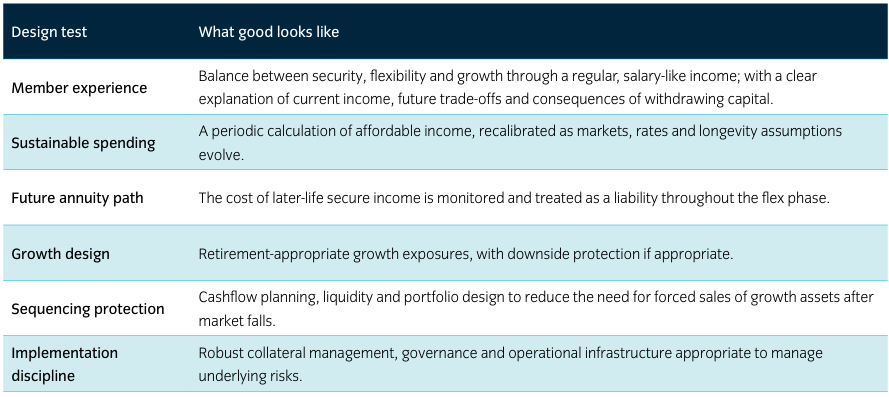
Governance should focus on outcome delivery. Key questions include how sustainable income is calculated and recalibrated, which risks are hedged versus retained, how growth exposures are protected or reshaped, and what sources of cash meet income in stress. Implementation discipline—particularly liquidity and collateral—supports resilience and confidence.
Figure 1: Governance checks for robust flex-then-fix delivery
The goal: confidence, not complexity
Flex-then-fix balances drawdown’s flexibility with annuities’ security when design manages the journey from day one. In our view, members should receive salary-like income, while the provider funds the future annuity deliberately, protects growth exposures and addresses sequencing risk. The goal is confidence to spend and trust that later-life security is being built into the journey.