

| Investors seeking higher income without materially increasing interest-rate sensitivity can step beyond cash. In our view, short-dated global credit, floating-rate credit and asset-backed securities can deliver contractual income while limiting duration risk. |  |
What you need to know
- Elevated policy rates and long-duration volatility make moving from cash into short-dated bonds timely now.
- Contractual income from short-dated and floating-rate credit can support resilience with less duration and spread sensitivity.
- Global short-dated investment grade and high yield can offer higher income than cash with shallower drawdowns.
- Asset-backed securities provide floating-rate income, diversification and structural protections that can complement corporate credit exposures.
Enhancing yield while managing duration risk
For investors still holding cash allocations, the current fixed income environment, in our view, offers a compelling opportunity to enhance income without taking significant interest-rate risk. Policy rates across developed markets remain attractive while long-dated bonds face greater volatility, reinforcing solutions that do not rely on duration exposure. Extending from cash into short-dated bonds can help lock in today’s elevated yields.
Policy expectations shift toward a more restrictive regime
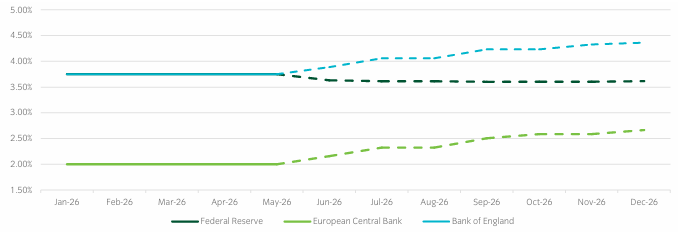
Recent developments have shifted expectations toward a more restrictive policy stance. In the US, markets imply an extended pause dependent on growth and inflation. In the UK, persistent services inflation and wage pressures increase the likelihood of reversing recent easing. In the euro area, energy-related inflation risks have led markets to price further tightening. These dynamics support selective moves beyond cash while keeping duration risk contained.
Figure 1: Market pricing of policy rates Caption: Elevated policy rates support short-dated income opportunities1.
How contractual income can aid portfolio resilience
The income-versus-duration trade-off is acute: the incremental income from extending duration is limited relative to higher rate sensitivity. Shorter-dated and floating-rate credit are less sensitive to moves in government yields, with returns driven more by contractual income and credit premia. This can support more predictable outcomes and limit reliance on favourable rate moves.
Four ways to potentially deliver attractive income with limited duration risk
1. Global short-dated investment grade credit: resilient income
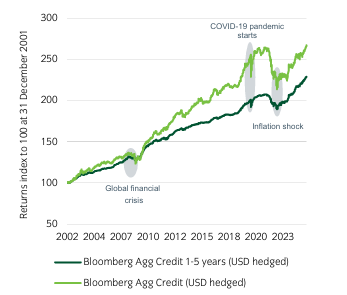
Short-dated investment grade credit captures much of the broader market’s income while taking materially less duration risk. Historically, it has shown lower realised volatility and shallower drawdowns, particularly during market stress, helped by lower rate and spread sensitivity and the pull-to-par effect. Shorter maturities also support frequent reinvestment at prevailing yields.
Figure 2: Short-dated IG has historically shown shallower drawdowns versus broader IG2.
2. Global short-dated high yield: focus on visible cash flows
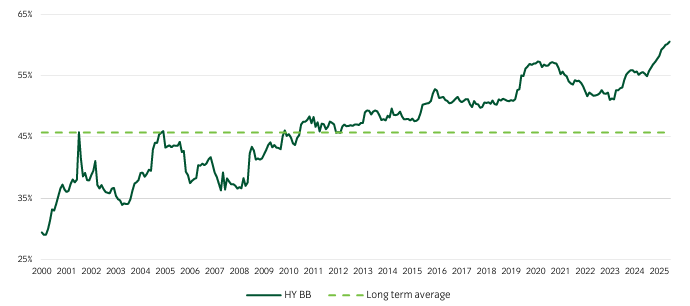
A short-dated approach focused on cashflows can help manage higher credit risk in high yield. Bonds maturing within two years can deliver higher yields than cash with outcomes driven mainly by coupons, offering greater predictability and reinvestment flexibility. The market’s quality mix has improved, with a larger share of BB-rated issuers.
Figure 3: The BB share within high yield has increased over time3.
3. Floating-rate credit: income that adapts
Floating-rate instruments reset coupons with market rates, resulting in very low interest-rate sensitivity and typically more stable prices than fixed-rate bonds. If rates remain elevated or rise, income adjusts accordingly. In our view, floating-rate corporate credit can complement moves beyond cash while maintaining a defensive profile against rate changes, with security selection remaining important.
4. Asset-backed securities: structured, floating-rate income
Many ABS provide floating-rate income and diversify away from corporate credit risk. Cashflows are backed by granular loan pools with structural protections such as subordination, excess spread and sequential payments. Historically low to moderate correlation with government bonds supports diversification, targeting cash-plus returns with controlled interest-rate and credit risk.
Building resilience with lower duration exposure
In our view, combining short-dated and floating-rate credit offers differentiated, carry-driven returns with flexibility to reinvest as conditions evolve. This enables investors to step out of cash in a controlled manner while maintaining resilience across a range of interest-rate scenarios.