

Fixed income markets are financing AI, creating potentially compelling spread opportunities across the credit spectrum in hyperscaler and cloud provider corporate bonds, digital infrastructure ABS and utility bonds.
Financing the AI revolution
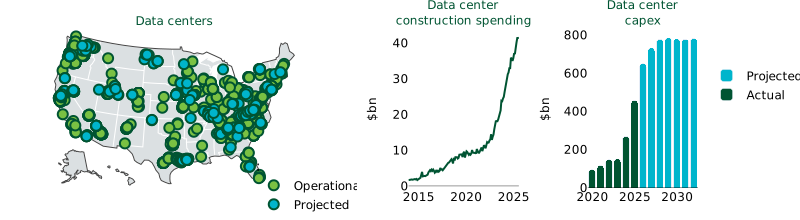
Three years after the launch of Chat GPT, the AI investment boom is in full swing. Data center investments alone are expected to reach $2trn to $3trn over the coming years (Figure 1). The industry is turning to fixed income markets for funding for this investment.
Figure 1: The AI investment boom is in full swing1
|
Three ways to consider allocating fixed income exposure to the AI boom
|
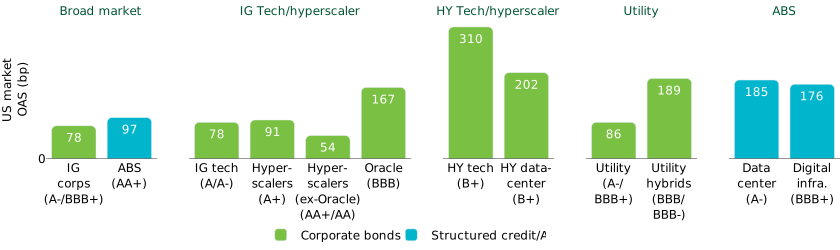
Figure 2: AI related sectors offer potentially compelling high credit quality source of spread2
1. Hyperscaler corporate bonds – high grade spread premia
Hyperscalers are well-placed to lead the AI race
Microsoft, Google, Meta, and Amazon3 are known as “hyperscalers” for their mastery of “horizontal scaling”, an innovation they mainstreamed in the 90s. This involves expanding computing power by networking more and more servers together (and distributing workloads across them) instead of continually upgrading central mainframes (“vertical scaling”).
To meet the growing demands of these firms’ web and, by the mid-2000s, cloud services platforms, their equipment outgrew their on-site server rooms and now fill sprawling networks of off-site data centers. The same scaling principle, alongside specialized chips, is exactly what the AI buildout demands, leaving the hyperscalers ideally placed to lead it.
Hyperscalers have turned to corporate bond markets
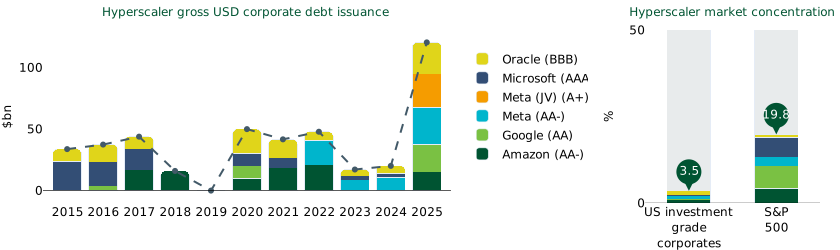
Hyperscalers were initially financing AI investments through (their considerable) free cash flow, but given the sheer scale of the capex demand, they also turned to corporate bond markets in 2025 (Figure 3 – left). This has increased their share of the investment grade market outstanding, but their concentration remains modest, in contrast to their dominance of US equity markets
(Figure 3 – right).
Figure 3: Hyperscaler issuance is ramping up, but their corporate bond market concentration is low for now3,4
One hyperscaler is the odd one out – but may not be worth dismissing
Oracle3, a cloud provider, is often grouped with the hyperscalers, but differs as it missed the initial web-driven horizontal scaling era, pivoting heavily from 2016 by raising significant debt to “catch up”. It was downgraded from A to mid-BBB in 2022.
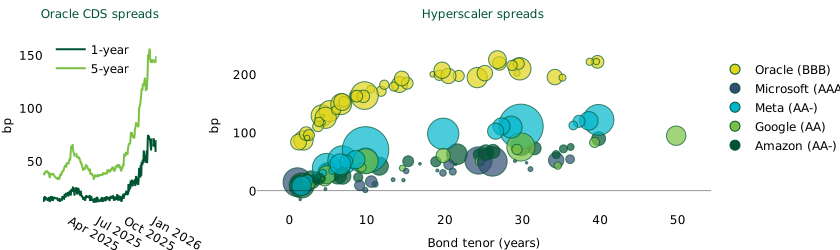
More recently, it has engaged in aggressive capex to position its platform as AI-friendly, raising leverage and liquidity concerns, which have been exacerbated by headlines around data center execution setbacks. Its CDS spreads widened sharply (Figure 4 – left) and bonds trade at 100-150bp wider than other hyperscalers (Figure 4 – right). We believe increased leverage could see the company’s credit rating fall to BBB-, close to “fallen angel” territory.
Figure 4: Oracle has drawn headlines and concerns over its aggressive use of debt to compete with the larger hyperscalers3,5
Nonetheless, we believe that spreads may already reflect a lower rating, meaning the issuer may still hold some value. Nvidia6 (the chief hyperscaler hardware vendor), began allocating chips more evenly across its customer base since 20247. Further, Oracle6 also has contractual agreements with Open AI6 (of Chat GPT fame), which we believe are favorable for Oracle bondholders, albeit possibly tying it more closely to the fate of Open AI than any of the other hyperscalers.
Higher spreads can be achievable outside the hyperscalers – but we believe surgical security selection is essential
Further down the risk spectrum, a few investment grade and a handful of high yield data center builders/operators and cloud providers have also ramped up their debt issuance.
Additionally, issuers (including hyperscalers) are looking at off balance sheet development finance structures to build specific data centers. Meta6 raised $27bn in the largest corporate project finance deal ever (at $27bn) for its Hyperion data center campus, through a joint venture with Blue Owl6. The debt offered a significant spread pick up over the issuer’s other bonds, partly given the lack of recourse to the Meta’s6 balance sheet. Smaller issuers typically need to tap high yield, loan and private credit markets for similar structures. Returns can be compelling (sometimes double digit) but require intense focus on credit and structural protection analysis.
2. ABS markets may offer AI-related cashflows with a complexity premium
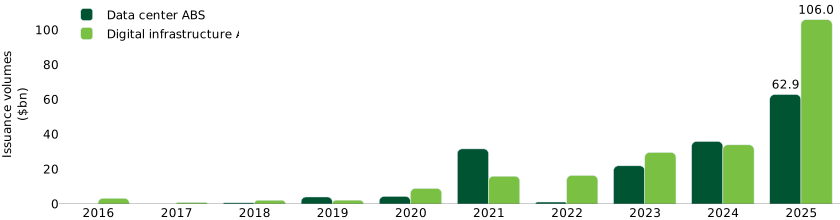
Esoteric ABS investors have had access to digital infrastructure investments – including data centers, but also fiber optic networks (the physical data highways connecting data centers) and cell towers (which enable wireless 5G access and real-time AI services like autonomous driving) – since at least 2016. The AI boom helped accelerate issuance sharply in 2025 (Figure 5).
Figure 5: Data center and digital infrastructure investments8
The assets underlying ABS deals are typically fully operational, post-revenue with contracted lease payments designed to meet the demands of ABS investors for predictable, dependable cashflows, and the avoidance of riskier development finance.
AI-related ABS can offer access to diversified cash flows
There are broadly two types of data center ABS. The first are securitized by lease payments on shelf space (like server racks or dedicated suites). Lessees often include hyperscalers, mid-sized cloud providers or software as a service (Saas) firms. The second are single asset single borrower (SASB) CMBS on specific data centers. We tend to favor deals backed by ABS lease deals in well-established data centers, particularly those backed by hyperscaler receivables.
Whether ABS or CMBS, the cashflows can be backed by either hyperscaler or “colocation” cashflows. Colocations are essentially multi-tenant data centers leased by smaller cloud operators, tech companies or “private cloud” enterprise customers. Colocations are often considered less safe than the hyperscaler deals given less lower average credit quality and short-term average leases. However, not all deals are equal. Some colocations spread credit risk across hundreds and thousands of investment grade tenants (rather than just one or two tech giants). We tend to prefer deals backed by established investment grade businesses and cloud providers, with caution for now toward smaller, newer AI businesses such as “neocloud” startups. We also prefer exposure to data center “hubs” (like Virgina) and leases structured with staggered maturities, which may improve operators’ ability to maintain and manage occupancy.
Fiber and cell towers deals follow similar leasing structures to the former. Builders lease fiber network capacity or tower antenna space respectively and securitize the cashflows. In our view, the “complexity premium” can be compelling but diligence (modeling, negotiation of structural protections and contractual analysis) is essential.
3. Utility sector corporate bonds
AI is energy-hungry, with US data center electricity demand projected to rise from ~35 GW in 2024 to between ~78GW and ~106GW by 20359 – potentially almost enough additional generation to match the UK’s entire installed power base10.
The US may be particularly well suited to deliver this. It implies ~8.6% more capacity11, which is achievable through its abundant supplies of low-cost shale gas where supply can be quickly scaled up. Natural gas is also well suited for delivering the high 24/7 energy baseloads required to train and run AI models non-stop for millions of users, as well as the high energy systems need for cooling.
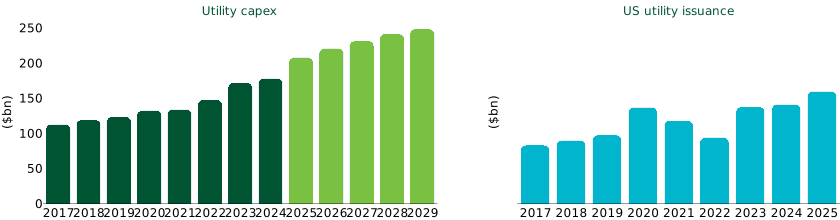
We expect utility capex to be manageable (~$1.1trn through 2029 under regulated frameworks – Figure 6, left). So far, the rise in bond issuance has been modest (Figure 6 – right). We expect bond holders should be shielded by the industry’s regulation frameworks, which require healthy rates of return and leverage oversight (which can drive hybrid bond issuance – which we currently consider attractive).
Figure 6: Utility capex to power AI may be manageable12
There are hurdles to overcome: historic data center clusters (like Virginia, Texas, and California) have seen energy‑price pressure and local opposition to new investment.
However, the uniquely disconnected nature of US grids offers utilities opportunities to partner with hyperscalers and data center operators to pursue higher‑capacity energy regions (like the Pacific Northwest, West Texas, and Arizona). Regulated utilities also have the latitude to charge high‑demand customers more, to compensate their existing users to help navigate political resistance.
Despite headlines noting hyperscalers investing in bespoke energy resources, like nuclear reactors, we do not expect that do be a significant theme, given their capital-intensive nature, expensive maintenance costs and idiosyncratic risks to tech capital structures.
What if AI is a bubble?For some, circular financing arrangements within the industry raise “dot-com” style red flags, as have execution risks around delayed data centers. Potential innovations that drastically lower power demand could also reduce investment needs. Ensuring robust exposure
In the event of an “AI bust”, lower quality debt and development finance among smaller issuers would likely carry the greatest risk. |
Conclusion: AI exposure in fixed income may offer quality and value
While equity markets perhaps has recently been dominated by AI-related companies, leading to concerns about concentration risk, valuations and volatility, we believe that fixed income investors can view AI-related bonds in a different light. In fixed income, AI-related debt, we believe, can offer attractive credit spreads for previously rare issuers with robust credit quality and / or structural protections.
This approach could offer the best of both worlds: a spread pickup from financing what may mark the start of the next industrial revolution, while providing robust diversification against equity exposure amid downside risks. However, success will depend on disciplined security selection, rigorous stress testing, and vigilant monitoring.