

|
Emerging oil product shortages from Middle East disruptions are elevating inflation risks and constraining growth. Our analysis maps inventory drawdowns and product dependencies, helping investors gauge implications for rates, credit spreads, currencies and portfolio liquidity. |
 |
- Closure and damage around the Strait of Hormuz reduced supply sharply, driving rapid global oil inventory drawdowns.
- Inflation pressures are rising as inventories approach lows, while demand destruction risks curtail growth in vulnerable economies.
- Product shortages will be uneven; India appears most exposed, while US resilience and China’s stockpiles provide buffers.
- Refinery capacity, net import reliance and inventory-flow modelling identify highest-risk products: jet fuel, gasoline and LPG.
- Investors should monitor re-opening progress, export restrictions and strategic reserve usage to assess rates, credit and liquidity.
Background
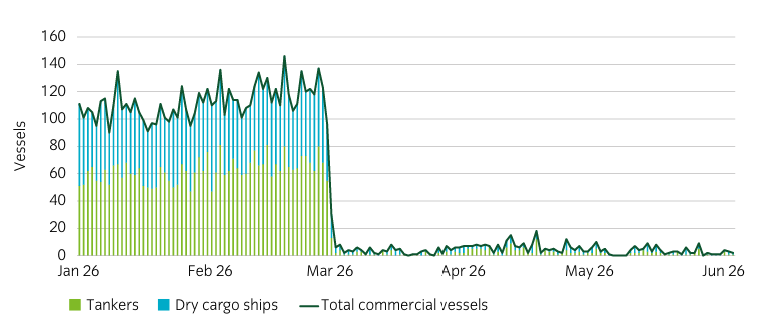
Disruptions through the Strait of Hormuz have heightened energy supply risk. Infrastructure damage across Qatar, Kuwait, Iraq, Bahrain, Iran and the UAE compounds bottlenecks, with repair timelines measured in years for some facilities. With supply contracting faster than demand, shortages are forming as inventories fall. The transmission to markets is inflationary, with growth pressure building as spending shifts toward energy. Investors need to track where product shortfalls appear first and how quickly demand destruction could stabilize prices.
Figure 1: Daily traffic through the Strait of Hormuz
Potential scenarios
Negotiated reopening provides relief but faces fragility, and damaged export infrastructure limits near-term throughput. A “frozen strait” scenario could sustain tighter supply and differentiated transit costs. Escalation risk would push prices higher and raise recession probabilities for import-dependent regions. Portfolio considerations include inflation risk premia, credit spread sensitivity, and potential policy responses, including strategic reserve releases or export curbs that may re-shape global trade flows and liquidity.
Measures of shortage risk
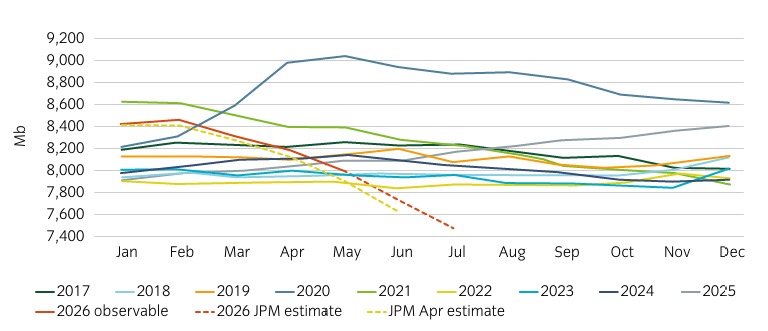
Global oil inventories are declining quickly, aided by strategic reserves, and risk approaching historic lows without further releases or improved flows. Days of net import cover vary widely, exposing countries below recommended levels. Refining capacity coverage is uneven, leaving some economies reliant on imports of gasoline, diesel and jet fuel. Product-level exposure differs; location quotients and net import reliance identify where bottlenecks matter most for activity, inflation dynamics and sectoral profitability.
Figure 2: Global oil inventories
Inventory-flow model and drawdown timelines
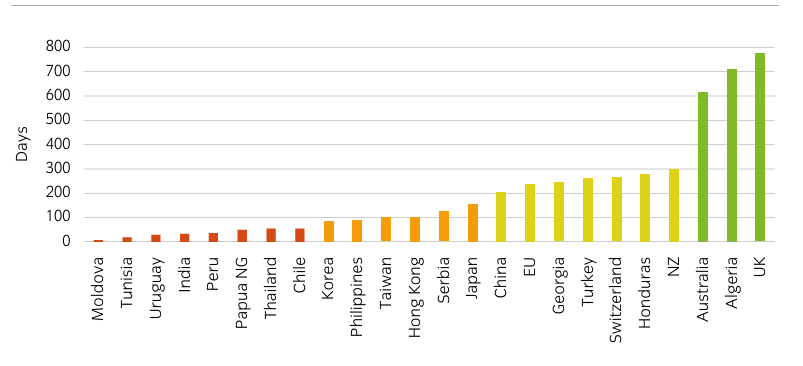
The inventory-flow model highlights uneven shortages across countries and products. India stands out as most exposed across LPG, gasoline, diesel and jet fuel, with evidence of demand contraction. Japan’s risk concentrates in naphtha, while the UK and EU are sensitive to jet fuel. The US has acted as exporter of last resort, aided by strategic reserves, but the pace may be unsustainable. Drawdown timelines help investors prioritize monitoring and contingency planning for critical products.
Figure 3: Diesel - days to drawdown
Regional breakdown and investor implications
India faces broad-based risks; Asia ex-China and parts of Latin America are vulnerable where import reliance and limited refining capacity intersect. China appears resilient due to large stockpiles. The US remains relatively insulated but has drawn on strategic reserves while shifting product output toward jet fuel. European energy dependence is product-specific; jet fuel remains a pressure point, with additional imports from the US and Nigeria’s new capacity providing a temporary buffer.
Conclusion
Investors face an energy-driven inflation shock with wide regional dispersion and product-specific bottlenecks. Monitoring inventory trajectories, refining constraints and policy responses can inform rates, credit and liquidity positioning. Maintaining portfolio resilience, scenario awareness and funding flexibility may help navigate uneven shortages and potential growth shocks.