

- The 2026 Budget is likely to prioritise stability over radical reform, with Chancellor Healey focused on reassuring gilt markets. Expected announcements include cost-of-living support, such as extended energy VAT relief.
- New spending is likely to be funded through targeted tax rises rather than radical reforms. Windfall taxes on banks and energy companies are reportedly in discussion.
- The prospect of a 2027 general election remains widely discussed, despite the prime minister’s explicit denial of any plans. The Labour Party is ahead in polls, and the prime minister’s priorities would be difficult to implement under the 2024 manifesto, which limits tax rises.
Unlike the previous Autumn Budget, few potential policies have been leaked and the chancellor has said little about the 2026 Budget’s contents. Suggestions from think tanks and pressure groups have dominated public debate but offered little insight into what the Budget may contain.
Prime Minister Burnham’s comments before and since his appointment, and particularly his Labour Party conference speech, offer some clues about the Budget’s likely contents1. Reports also suggest the next Spending Review, expected in spring 2027, may be delayed until the autumn and published alongside that year’s Budget2.
It seems probable, therefore, that this year’s Budget will be focused more on ‘do no harm’ than anything more radical.
Possible policies in the 2026 budget
A Budget with little impact on financial markets would allow the prime minister to devote his political time and energy in November towards developing and implementing his priorities.
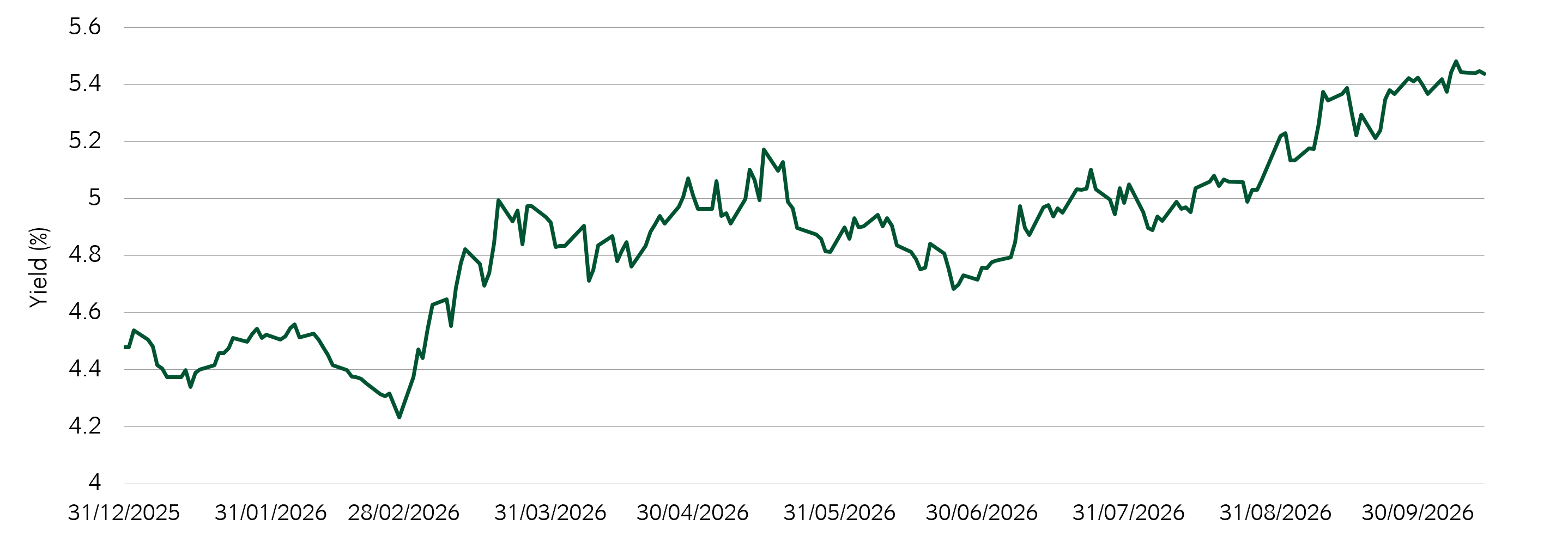
After recent gilt market volatility (see Figure 1), a key priority for the chancellor will be to reassure gilt investors. To do this, he is expected to continue to meet the UK’s fiscal rules.
Figure 1: 10-year gilt yields have been volatile, and risen materially, this year
Moreover, we also expect him to preserve £15bn to £20bn buffer to the headroom against those rules, a slightly lower number than in former Chancellor Reeves’s last Budget.
A second priority is fulfilling the prime minister’s commitment to lead a “cost of living government”3. It is probable, therefore, that the Budget will offer short-term relief to selected households and businesses in response to the sharp rise in energy prices this summer.
Support for households is likely to be means-tested, while measures for businesses may target smaller firms.
Possible new policies include:
- Extending the VAT cut in electricity. At present, government policy has cut VAT to 0% on domestic electricity bills to the end of March 20274. The government could extend the duration of the VAT cut.
- Extending the fuel duty freeze. The 5p cut was extended in May to end on 31 December 20265, with RPI indexation resuming in April 2027. This freeze could be extended further.
- A further freeze in rail fares. Former Chancellor Rachel Reeves announced a freeze to rail fares across the country6 until March 2027. Without the freeze, the default rise in regulated rail fares is July RPI plus 1%. This freeze could be extended.
- Freezing prescription charges. Prescription charges in England have been set at £9.90 per item since April 2024, having been frozen twice since then, and this freeze could be extended.
- A targeted increase in the Warm Homes Discount. This could be introduced as part of a one-off winter support package aimed at partially offsetting the January Ofgem Price Cap increase.
Introducing such measures in a market-friendly way will be difficult, especially if the Chancellor is looking to deliver a budget low on political risk, which means any revenue-raising measures are unlikely to come from radical reform of the taxation system. Instead, it seems likely that stealth or targeted tax hikes will remain the lever of choice. Possible tax increases could include:
- New or increased taxation of banks or energy companies. The Treasury has reportedly been considering a windfall tax, or other tax measures, on banks and oil companies since the summer7. With regard to banks specifically, the chancellor is said to be “poised” to raise taxes after pressure from Labour backbenchers and union chiefs to do so8.
- Increasing capital gains tax. The chancellor has reportedly ruled out equalising capital gains tax with income tax9, but it remains possible that the tax could be increased.
An early general election?
A question being asked widely is whether the government is planning a General Election in early 2027, thus allowing the prime minister to implement an economic plan that is not constrained by the party’s 2024 election manifesto – which included promises not to raise income tax, National Insurance or VAT.
The prime minister’s insistence that he will not call an election before 202910 has done little to dampen speculation. This is perhaps unsurprising, as since becoming prime minister, Burnham’s ambitious rhetoric about changing the UK – promising “the biggest changes in the last forty years”, referring to a “new political model and a new economic model”11 – suggest a desire to introduce radical policies that were not in the previous manifesto, which has led to speculation in the media around the possibility of an early election.
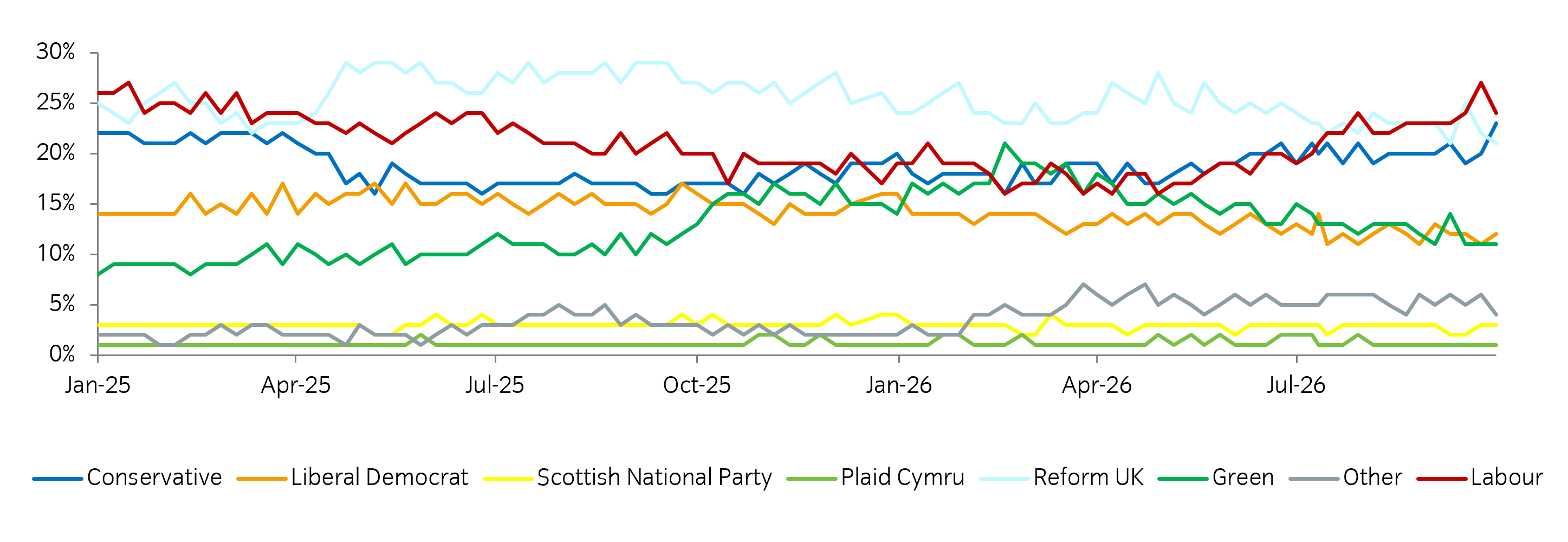
However, whilst polls indicate some evidence of a ‘Burnham bounce’ and an increase in the Labour Party’s popularity, current expectations are that, based on current polls, an early election would result in a fragmented Parliament with Labour having a significantly reduced majority (see Figure 2).
Figure 2: Polls suggest a risk that no party would get a clear majority12
Whenever the next election might be, Prime Minister Burnham’s party conference speech offers an outline of the key policies that will likely feature in the next Labour Party manifesto. Key emphases are likely to be breaking from “past economic models”, as per the prime minister’s first speech, and bringing essential services into public control.
Prime Minister Burnham’s key emphases: policies for the next Labour Party manifesto?
1. Social care and pensions
– National Care Service: Establish a new, fully funded National Care Service in the next Parliament, providing free personal care for older people modelled on the NHS.
– Pension ‘triple lock’ adjustment: Reform and adjust the state pension triple lock from April 2030 by moving to a baseline of inflation or 2.5%, removing the automatic earnings link, to help finance the National Care Service.
2. Public ownership and utilities
– Water services: Repeal the Thatcher-era ban on public ownership of water companies, increase public control over the water system, expand mayoral accountability powers, and tighten restrictions on executive bonuses.
– Energy and grid: Launch the ‘Great British Grid’ under Great British Energy to accelerate connections and cut electricity costs.
3. Housing and communities
– Council housing and building: Launch a large-scale council house building programme.
– Tenants' rights and reform: Reform the Right to Buy scheme, acquire poorly maintained empty or rented properties, introduce ‘Your First Home’ initiatives, enforce crackdowns on rogue landlords, and deliver comprehensive leasehold reform.
– Ending rough sleeping: Implement policies to end rough sleeping nationwide.
4. Democratic and electoral reform
– National commission on electoral reform: Commit to changing the first-past-the-post system to elect MPs, launching a cross-party national commission to consider how to reform the electoral system.
5. UK-EU relations
– Long-term European strategy: Consider a stronger, closer, long-term relationship with the EU.
What this means for the gilt market
Markets are understandably sensitive to any sign that politicians may relax borrowing rules or increase unfunded spending commitments.
Andy Burnham stated in an interview last year: “We’ve got to get beyond this thing of being in hock to the bond market”13. Gilt yields rose sharply in response. Burnham later qualified his comments, pledging he would stick to the government’s fiscal rules14, and 10-year gilt yields dropped sharply.
The gilt market has weathered a variety of storms in recent months. Developments in the Middle East, rising inflation, and domestic political risk are all stoking fears over the potential for economic stagflation and the UK’s medium-term fiscal outlook.
However, the gilt market has already moved substantially to price in these risks, with markets expecting significant rate increases by the Bank of England. Shorter-dated gilts will likely remain particularly sensitive to changes in energy prices, while the notable shortening of the average maturity of UK debt issuance over the past year provides a constructive supply backdrop for longer-dated gilts.
Ultimately, the Budget is likely to be less about changing direction than buying time. A cautious package could steady the gilt market and ease immediate cost pressures, but it would leave the government’s larger ambitions, and the question of how to fund them, for another day. The can may be kicked down the road, but investors will remain focused on where it eventually lands.