




Institutional investors are forced to balance their strategic objectives with volatility, liquidity needs, governance constraints, and multi‑manager complexity. However, we believe an overlay partner can allow for timely, targeted adjustments through flexible, capital-efficient and disciplined implementation, while keeping investors aligned to their strategic frameworks.
Timely portfolio adjustments without costly trading of physical assets
An overlay is a synthetic derivatives portfolio that allows investors to adjust market exposures independently of their physical assets. It requires minimal initial capital, and investors exchange collateral rather than full cash funding. As such overlay instruments are economically similar to funding the purchase of physical assets at overnight rates (Figure 1).
Figure 1: Overlays may offer capital efficient risk exposures1

We believe overlays may offer:
- Capital efficiency: adjust exposures to target levels without reallocating physical assets.
- Execution efficiency: faster, at lower trading costs than physical securities, even in stressed markets.
- Flexibility: application across equity, rate, credit, currency, and commodity markets.
- Scalability: usable for incremental adjustments or full multi‑asset implementations.
These features may allow overlays to support strategic portfolio alignment without disrupting underlying allocations or manager structures.
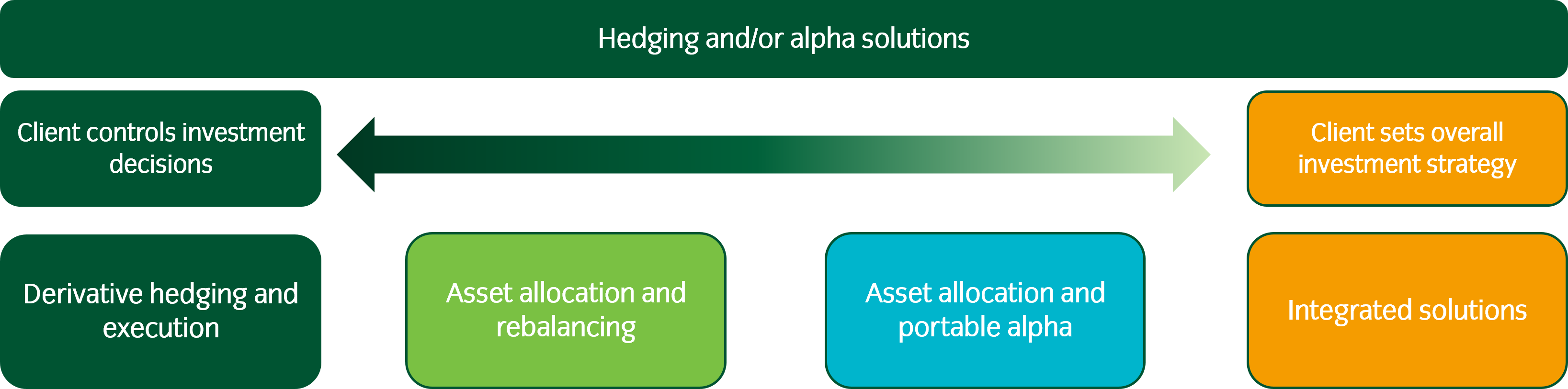
Clients may benefit from implementation approaches. They range from retaining full control over each investment decision to allowing managers latitude to execute transactions in line with the client’s defined investment strategy.
Figure 2: Clients can consider a spectrum of control over their overlay solutions1
Three potential key benefits of overlays
1. Reduce transaction costs and deliver precise implementation
In multi‑manager structures, portfolio drift from policy targets is common. Overlays provide a centralized mechanism to rebalance exposures, manage hedge ratios, align yield curve positioning, and reduce tracking error with typically lower frictional costs.
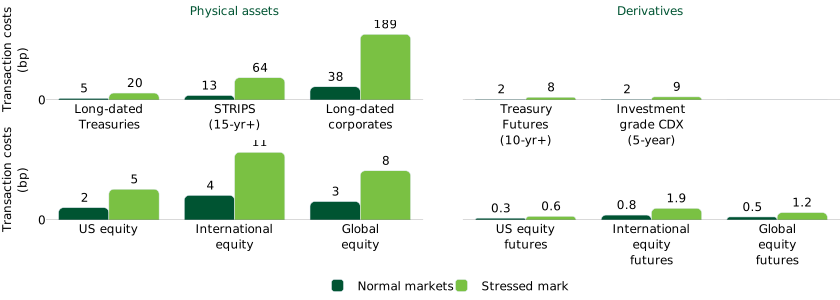
Derivatives typically have materially lower trading costs than their physical counterparts. The difference can be particularly stark through stressed markets. Overlays can therefore potentially allow tighter adherence to strategic market exposure targets with less turnover. Overlays can open the door to exposures that would be impractical or costly to obtain physically, such as inflation‑sensitive assets, alternative betas, or targeted rates, currency or credit exposures.
Figure 3: Transaction costs for derivatives can be a fraction of physical assets2
2. Strengthen liquidity and reduce cash drag
Portfolios routinely experience inflows and outflows from contributions, distributions, transitions, and capital calls. Overlays allow investors to maintain target market and duration exposures when cash must be held or when physical assets are sold, helping manage both cash drag and unintended exposure drift from policy targets. Synthetic exposure adjustments can free up portfolios to manage cashflow needs without needing to liquidate physical assets, reducing forced‑selling and risks relating to sequencing of returns.
3. Implement tactical views efficiently
Overlays enable efficient tactical exposure tilts or portable alpha strategies through equities, rates, commodities, currencies and volatility instruments quickly and at low cost, without disrupting a manager lineup.
Overlays may also help customize return profiles
Overlay strategies can also help improve a portfolio’s risk‑return profile.
Within predefined governance frameworks, tactical overlays allow exposures to be adjusted within established ranges in response to changing market conditions, providing a potentially capital‑efficient way to express short or medium‑term views without altering the underlying manager structure.
Return‑seeking overlays can also incorporate strategies like portable alpha, in which synthetic instruments deliver beta while physical capital is allocated to alpha‑seeking strategies. Separating beta and alpha can potentially improve implementation efficiency and free up capital for higher‑priority investments.
Options‑based overlays can also introduce convexity exposure, increase downside protection potential, or generate income through systematic premium‑selling strategies. These tools can help portfolios potentially participate in rising markets while supporting risk mitigation or income generation during quieter periods.
A robust governance framework is essential
We believe strong operational infrastructure and a disciplined governance framework are essential for a well-designed overlay program. As such, we believe partnering with an experienced overlay manager is critical.
Selecting the most appropriate instruments for achieving desired exposure sits at the heart of governance. For example, an overlay manager must determine if exchange-traded or over-the-counter (OTC) derivatives are best suited. The former can offer transparency, deep liquidity, and rapid execution (particularly valuable during market stress) while OTC instruments (such as swaps or customized total return structures) may provide enhanced flexibility regarding tenor, collateral terms, and structure. We consider aligning the right instruments with liquidity needs, risk appetite, and long-term objectives to be foundational governance.
Investors also need the most suitable exposures for synthetic replication. For example, highly liquid and transparent markets such as government bonds and broad equity indices tend to track closely to their derivatives. We believe this can make them well-suited for efficient, low-tracking-error strategies.
However, further down liquidity spectrum, basis and replication risks can rise due to rising market segmentation, heterogeneous cash flow characteristics, and less consistent pricing. This is not to say synthetic tools cannot add value in less liquid markets, but it becomes important for disciplined framework to measure, monitor, and manage expected tracking error, sources of slippage, and the trade-off between precision and capital efficiency.
Figure 4: Implementing overlays down the liquidity spectrum requires additional considerations3

A well‑designed governance framework should, in our view, support multiple implementation routes and provide continuous monitoring of exposures, financing costs, and collateral needs so target exposures can be maintained across different liquidity or volatility regimes and tracking error is managed proactively.
Collateral and counterparty management plays a central role in maintaining the stability of an overlay program. Derivatives are marked to market daily, and margin changes need efficient processing to avoid liquidity strain or unintended leverage. Diversifying collateral flows across counterparties and clearing brokers can reduce concentration risk and potentially strengthen pricing outcomes through competitive execution.
Many asset owners now operate under a Total Portfolio Approach (TPA), emphasizing a single portfolio, a unified risk budget, and centralized balance sheet management. Within this model, overlays may provide the connective tissue that links strategic exposure decisions with daily implementation. They can potentially manage financing, collateral, and rebalancing at the total fund level, helping ensure that policy exposures are maintained consistently across multiple managers, asset classes, and liquidity profiles.
Given the strategic importance of an overlay mandate to successful execution of an investor’s strategy, the overlay manager can play a key governance role, offering independent oversight of exposures, pricing models, hedge ratios, stress-testing practices, and liquidity metrics to help ensure exposures remain aligned with objectives and help strengthen long-term resilience. Overlay managers can oversee the full lifecycle of implementation, from data and exposure analysis to execution, collateral management and reporting. This can allow investment committees and governance bodies to focus more on strategic direction.
Conclusion
We believe overlay strategies are essential tools for capital efficiency, liquidity resilience, and tight alignment with strategic objectives. By separating the task of managing exposure from physical allocation, overlays may offer a powerful mechanism for responding to market conditions without undermining long‑term structure.


Most read
Fixed income

February 2026
Monthly fixed income review and outlook
Global macro, Economics

June 2025
Global Macro Research: State of the world
Fixed income, Video

February 2025
Systematic fixed income explained
Liability-driven investment

November 2025